How I Coordinate Multiple AI Agents with Orca
When working with multiple AI agents, a new problem quickly appears: distributing tasks, sharing context, managing code changes, and verifying results. If you handle all of this manually, you lose some of the benefits of automation. That's why…
 Oleksii Strokan4 min read
When working with multiple AI agents, a new problem quickly appears: distributing tasks, sharing context, managing code changes, and verifying results.
If you handle all of this manually, you lose some of the benefits of automation.
That's why I use Orca with my own orchestration prompt. The goal is to coordinate multiple AI models and make sure their work leads to a verified result.
How My Workflow Works
The main idea is to separate responsibilities between agents.
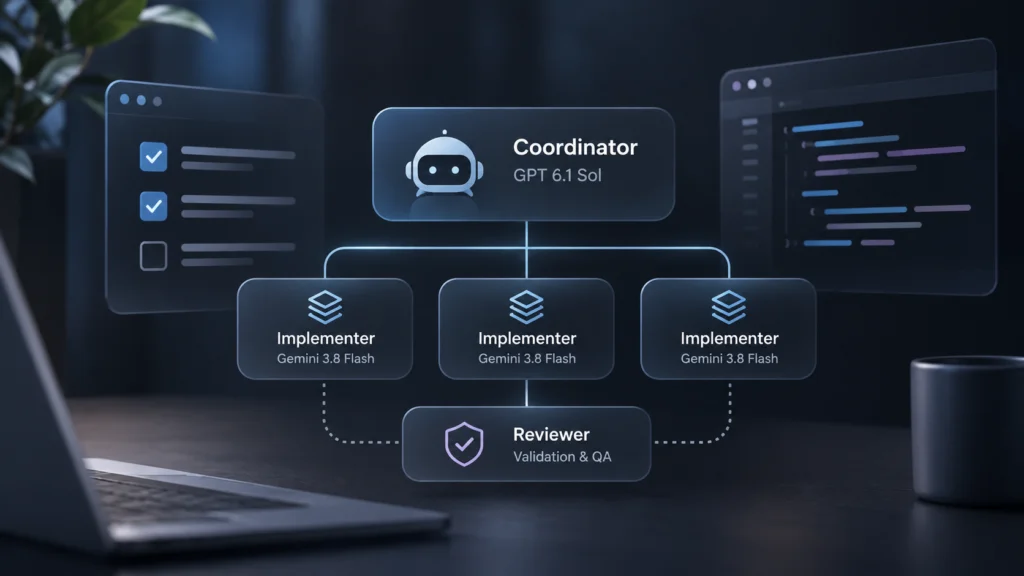
In my setup, GPT 6.1 Sol acts as the coordinator. It analyzes requirements, makes architectural decisions, distributes tasks, and reviews the final result.
Gemini 3.8 Flash High, through Antigravity, handles implementation tasks. For significant changes, a separate reviewer checks the work.
I follow a few basic rules:
- Small tasks go to one agent. Independent tasks can run in parallel.
- Each modified file has one responsible agent.
- Shared components and integration remain under the coordinator's control.
- If an agent gets stuck, it reports the problem and previous attempts instead of repeating the same mistakes.
- A task isn't complete until its results have been verified.
My Orca Orchestration Prompt
Here's the full prompt I use to organize this workflow.
You only need to specify the project and the task. Orca handles the coordination, provided the required tools and permissions are available.
Use /orchestration

PROJECT: [name, path, or repository URL]
TASK: [what needs to be done and the expected result]

Organize the work and bring the task to a verified result.

MODELS AND ROLES

Preferred coordinator: GPT 6.1 Sol. Responsible for defining expected behavior, designing the solution, and accepting the final result.

Implementers: Gemini 3.8 Flash High through the available Antigravity integration. Assign them tasks with clear acceptance criteria. They are the primary implementation agents. Assign implementers and reviewers as needed.

ORGANIZATION

1. Read the project instructions, inspect the current state, and preserve existing changes. Verify the task's initial assumptions.

2. Create a brief plan. Identify independent tasks and dependencies. Use one agent for small tasks; when appropriate, run up to three implementers in parallel.

3. Give each implementer a clear goal, necessary context, scope boundaries, owned files or artifacts, and acceptance criteria. Within a shared working directory, each modified file must have exactly one owner. Shared files and integration are managed by the coordinator.

4. Keep ambiguous requirements, architectural decisions, security concerns, and changes affecting multiple interconnected modules under the coordinator's control. After two failed attempts, the implementer must escalate the issue with evidence and results from previous attempts.

5. Use Orca's native orchestration capabilities. Track questions, completed tasks, and blockers. Reuse suitable sessions and release those no longer needed.

VERIFICATION

For significant changes, assign an independent reviewer who receives the original requirements, the changes, and the test results. The coordinator resolves review findings and verifies the integrated result.

AUTONOMY

Make routine implementation decisions independently. Ask for input only when required access is missing, significant ambiguity exists, or an action falls outside the authorized scope.

Follow the project's instructions for Git, publishing, and deployment. Reuse permissions already granted. If additional authorization is genuinely required, first prepare a concrete result for review.

Keep updates about important decisions, results, and blockers brief.

FINAL REPORT

Report what was completed, how it was verified, what remains unfinished, and why.

Include the models actually used and the location of the deliverables.

Provide a final status for each requirement.
What to Keep in Mind
This prompt is designed around my development environment. You can replace the models and Antigravity integration with your preferred tools, but the environment must actually support multi-agent execution and coordination.
Another important point: parallel execution isn't always faster. When several agents modify interconnected components, you can easily spend more time resolving conflicts than you save.
That's why I prefer keeping smaller tasks simple.
The prompt itself doesn't guarantee quality either. Without proper tests, project access, and real verification, even a well-organized agent workflow can produce incorrect results.
It's About Results, Not Agent Count
For me, orchestration isn't about running as many AI models as possible.
It's about delegating implementation work while keeping control over architecture, security, and code quality.
A good multi-agent system isn't defined by how many agents it runs. It's defined by clear responsibilities, reliable verification, and knowing what happens when something goes wrong.