
Helping AI Agents Read Your Site: Why Markdown Files Matter for Pricing and Docs
When chatbots and AI agents decide which websites to reference in their answers, they rely on how easily they can parse and understand the underlying structure of a site. As more traffic begins to originate from AI-driven queries…
 Oleksii Strokan3 min read
When chatbots and AI agents decide which websites to reference in their answers, they rely on how easily they can parse and understand the underlying structure of a site. As more traffic begins to originate from AI-driven queries rather than traditional search engines, developers and site owners face a new kind of optimization problem.
One practical technique that has emerged involves catering directly to how these language models consume data, moving beyond standard HTML to feed clean, structured text straight to the crawler.
The Problem with Modern UI Elements for AI
Complex web interfaces that rely heavily on JavaScript for core information often create friction for automated agents. For instance, a startup dealing with intricate pricing tiers found that AI agents frequently struggled to parse interactive pricing calculators and sliders driven by client-side scripts.
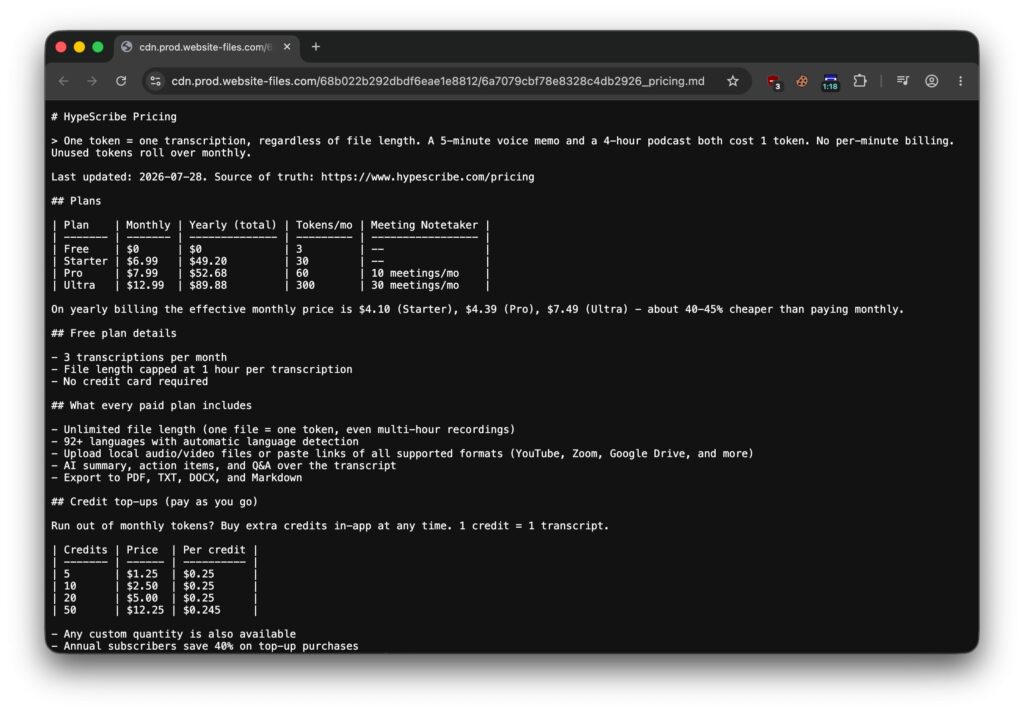
Instead of trying to rewrite the frontend interface or relying on the agent's ability to execute and interpret heavy JavaScript, the team took a simpler approach: they extracted all pricing data, plan features, and tiers into a plain Markdown file.
By utilizing an llms.txt file—a convention gaining traction for guiding AI agents through a site—they provided a direct link to this structured document. When an agent lands on the site and needs clarification on pricing, it can bypass the interactive UI entirely, read the llms.txt index, fetch the clean Markdown file, and ingest the exact figures and details with minimal effort and token waste.
Expanding Markdown Architecture Across the Site
This concept doesn't have to stop at pricing. The same principle can be applied to other critical sections of a website that agents often need to query:
- Changelogs and Release Notes: Providing raw text versions of product updates helps agents accurately answer queries about when a specific feature was shipped.
- Documentation and Security Pages: Technical specifications, compliance guidelines, and security policies benefit immensely from being readable without nested DOM trees or complex styling.
- Structured Tables: When utilizing tables within these Markdown documents, explicit labeling and clean structuring ensure the agent correctly interprets the relationship between rows, columns, and values.
The core rule here is maintaining strict synchronization. The human-facing pages and the AI-facing Markdown files must serve as a single source of truth. If a price changes on the main pricing page, the corresponding .md file must be updated simultaneously.
Implementation and Limitations
Implementing this approach requires very little overhead. Developers can generate these static Markdown files alongside their standard builds and place them in a designated directory. Because these files do not need to be indexed by traditional search engines for standard users, they operate quietly in the background.
At the same time, it is worth keeping expectations realistic. Whether an agent actually discovers and utilizes these files depends entirely on its specific fetching capabilities, search tools, and the exact context of the user's prompt.
Even so, adding a clean, text-only alternative costs almost nothing in terms of performance or maintenance, and it can significantly improve how accurately AI systems represent a product or service when users ask questions.